seolounge
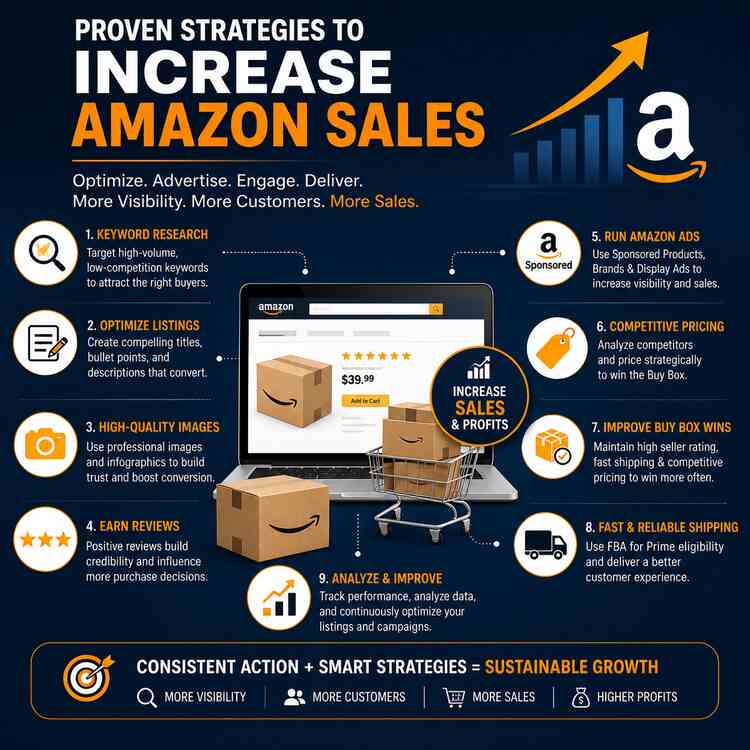
Selling on Amazon in 2026 is no longer just about listing a good product and waiting for customers to find it. Competition is tougher, shoppers are more selective, and Amazon’s marketplace continues to become more sophisticated. Sellers need to think beyond basic product listings and build a strategy that combines Amazon SEO, compelling content, advertising, pricing, customer experience, reviews, and data-driven optimisation.
The good news? You don’t necessarily need hundreds of products or an enormous advertising budget to grow. A well-optimised product, the right keywords, strong visuals, competitive pricing, and smart advertising can make a significant difference.
Whether you are launching a new Amazon product or trying to improve sales for an established listing, the following strategies can help you increase Amazon sales in 2026.
Why Increasing Amazon Sales Requires a Smarter Strategy in 2026
Amazon has become highly competitive across almost every major category. Customers can compare dozens of similar products within seconds, while sellers compete for visibility both organically and through paid placements.
Simply driving more traffic to your listing isn’t enough. You need to turn that traffic into customers.
A successful Amazon sales strategy should focus on four core areas:
- Visibility: Getting your products in front of relevant shoppers.
- Conversion: Persuading visitors to purchase.
- Customer experience: Building trust before and after the sale.
- Profitability: Growing revenue without allowing advertising and operational costs to eat into margins.
This means sellers should focus on the entire customer journey rather than treating Amazon as just another sales channel.
Optimise Your Amazon Product Listings
Your product listing is your digital storefront. Before investing more money in advertising, make sure your listing is capable of converting the traffic you already receive. An optimised Amazon listing should include:
- A clear, keyword-focused product title
- Relevant bullet points
- Detailed product descriptions
- High-quality product images
- Appropriate backend search terms
- Relevant product attributes
- Strong calls to action where appropriate
Your listing should answer the questions a customer is likely to have before buying. Instead of simply saying that a product is “high quality,” explain what makes it useful. Instead of stuffing keywords into a title, use keywords naturally while clearly communicating the product’s main benefit.
Benefits of Listing Optimisation
A well-optimised listing can help:
- Improve organic search visibility
- Increase click-through rates
- Improve conversion rates
- Reduce customer confusion
- Support Amazon advertising performance
- Generate more sales from existing traffic
Think of listing optimisation as improving the salesperson on your digital shop floor.
Conduct Amazon Keyword Research
Keywords remain an important part of Amazon SEO in 2026. However, effective keyword research isn’t about finding the highest-volume keyword and repeating it everywhere. You need to understand what shoppers are actually looking for and where they are in the buying journey. For example, someone searching for “running shoes” has a broad intent. Someone searching for “men’s waterproof running shoes for trail” has a much more specific requirement. Look for a mix of:
- Primary keywords
- Long-tail keywords
- Product-specific terms
- Feature-based keywords
- Problem-based search terms
- Competitor and alternative terms where appropriate
Use relevant keywords naturally in your:
- Product title
- Bullet points
- Product description
- Backend search terms
- A+ Content where relevant
Feature: Search Intent-Based Optimisation
Rather than focusing solely on search volume, map keywords according to customer intent.
Benefit: This can help attract more qualified shoppers who are more likely to purchase.
Write Product Titles for Humans and Search
Your Amazon title has two jobs: help Amazon understand your product and help customers understand what you’re selling.
A strong title should quickly communicate:
Brand + Product Type + Key Feature + Size/Quantity + Important Differentiator
Avoid making the title unreadable by filling it with repetitive keywords.
For example, instead of:
Premium Running Shoes Running Shoes Men Shoes Sports Shoes Comfortable Shoes
Use something more natural:
Men’s Trail Running Shoes with Cushioned Sole – Lightweight Waterproof Outdoor Sports Shoes
The second version communicates the product clearly while still incorporating relevant search terms.
Upgrade Your Product Images
Images can have a huge influence on buying decisions. Customers cannot physically touch or inspect your product on Amazon, so your images need to do much of that work for them. Your image strategy should include:
- A clean primary product image
- Multiple product angles
- Close-up shots of important features
- Lifestyle images
- Product dimensions
- Feature callouts
- Usage examples
- Comparison graphics where appropriate
Your main image should make the product immediately understandable. Additional images should answer questions and remove purchase hesitation.
Benefits of Better Product Images
High-quality visuals can help:
- Increase listing engagement
- Communicate product benefits faster
- Reduce uncertainty
- Improve conversion potential
- Differentiate your product from competing listings
A customer may read every word in your listing, but many will decide whether to keep exploring based on the images first.
Create More Persuasive Product Descriptions
Your product description should not read like a manufacturer’s instruction manual. Instead, connect product features with customer benefits.
For example:
Feature: 10-hour battery life.
Benefit: Use the device throughout the day without constantly searching for a charger.
This simple feature-to-benefit approach makes your product more relevant to shoppers.
Focus your copy on:
- What the product does
- Who it is designed for
- What problem it solves
- Why it is different
- How customers can use it
- What makes it worth buying
Use A+ Content to Strengthen Your Brand
A+ Content gives eligible sellers an opportunity to go beyond basic product descriptions and create a richer shopping experience. You can use it to showcase:
- Brand stories
- Product benefits
- Feature comparisons
- Product use cases
- Lifestyle imagery
- Product ranges
- Frequently asked questions
- Brand differentiators
A+ Content should not simply repeat your bullet points. Use it to provide additional context and strengthen the customer’s confidence in your brand.
Key Benefit
Better brand storytelling can help customers understand why they should choose your product instead of a similar competitor.
Build a Strong Amazon PPC Strategy
Amazon advertising can put your products in front of shoppers who are already searching for something to buy. But simply increasing your advertising budget isn’t a strategy. A more effective PPC approach involves separating campaigns based on objectives. For example:
Sponsored Products
Useful for promoting individual products and targeting relevant shopping searches.
Sponsored Brands
Useful for increasing brand visibility and promoting multiple products where eligible.
Sponsored Display
Can support product and audience targeting opportunities across Amazon’s advertising ecosystem, depending on eligibility and campaign setup.
PPC Campaign Structure
Consider separating campaigns into:
- Automatic campaigns
- Manual keyword campaigns
- Exact-match campaigns
- Phrase-match campaigns
- Broad-match campaigns
- Product targeting campaigns
- Branded keyword campaigns
- Competitor/product targeting campaigns
The exact structure should depend on your category, product margins, search volume, and advertising data.
Optimise Amazon PPC Based on Profit, Not Just Sales
One of the biggest mistakes sellers make is celebrating revenue while ignoring profitability. A campaign generating $10,000 in sales isn’t necessarily successful if it costs $9,000 to generate those sales. Track metrics such as:
- Advertising Cost of Sales (ACOS)
- Total Advertising Cost of Sales (TACOS)
- Return on Ad Spend (ROAS)
- Conversion rate
- Click-through rate
- Cost per click
- Impressions
- Orders
- Organic sales
- Overall contribution margin
The goal isn’t always to achieve the lowest ACOS. Sometimes a higher ACOS is acceptable if advertising is helping launch a new product, build market share, or generate profitable repeat customers.
The Key Benefit
Profit-focused PPC optimisation helps you scale sales without blindly increasing advertising costs.
Improve Your Amazon Conversion Rate
Getting visitors to your listing is only half the job. If 1,000 shoppers visit your product page and only five purchase, simply increasing traffic may not solve the underlying problem. Look at your listing from a customer’s perspective. Ask:
- Is the product immediately understandable?
- Are the benefits obvious?
- Do the images answer common questions?
- Is the price competitive?
- Are reviews strong enough to build trust?
- Does the listing address customer objections?
- Is there enough information to make a confident decision?
Small improvements to conversion rate can have a significant impact because they allow you to generate more sales from the same amount of traffic.
Use Customer Reviews as a Growth Tool
Reviews are one of the strongest forms of social proof on Amazon. A product with hundreds of positive reviews can naturally create more confidence than an otherwise similar product with very little feedback.
However, the goal shouldn’t be to chase reviews through questionable tactics. Instead, focus on delivering a product and customer experience that genuinely deserves positive feedback. Pay attention to recurring review themes. If customers repeatedly say:
- “The packaging was difficult to open”
- “The size runs small”
- “The instructions aren’t clear”
- “The product is great but the cable is too short”
those comments provide valuable product-development information.
Benefit
Reviews don’t just influence shoppers. They can help you identify weaknesses and improve the actual product.
Analyse Negative Reviews and Questions
Negative reviews can be uncomfortable to read, but they can be extremely useful. Create a simple feedback analysis:
| Customer Feedback | Possible Issue | Action |
| “Too small” | Sizing problem | Improve sizing information |
| “Hard to use” | Poor instructions | Add clearer instructions |
| “Looks different” | Image mismatch | Improve product photography |
| “Packaging damaged” | Packaging weakness | Improve packaging |
| “Battery doesn’t last” | Expectation mismatch | Clarify battery performance |
This turns customer feedback into an optimisation process.
Improve Your Pricing Strategy
Price is one of the easiest things customers can compare on Amazon. That doesn’t mean you should always be the cheapest seller.
Instead, aim for competitive value.
Monitor:
- Competitor prices
- Promotions
- Coupons
- Your margins
- Customer perception
- Product quality
- Shipping and fulfilment costs
- Seasonal demand
If your product is more expensive than competitors, your listing needs to clearly communicate why. A premium price without a clear reason can create resistance. A premium price supported by better quality, features, warranty, design, or service can be easier for customers to justify.
Use Coupons and Promotions Strategically
Discounts can encourage customers to make a purchase, particularly when they are comparing several similar products. Common promotional approaches include:
- Coupons
- Percentage discounts
- Limited-time offers
- Buy-one/get-one promotions where suitable
- Seasonal promotions
- Event-based promotions
However, discounting should not become a permanent habit. If customers only buy when your product is discounted, you may have a positioning or pricing problem. Use promotions strategically to create urgency, support launches, clear inventory, or increase visibility during important shopping periods.
Take Advantage of Seasonal Demand
Many Amazon products experience predictable demand patterns. Depending on your category, sales may increase during:
- Holiday shopping periods
- Back-to-school seasons
- Summer
- Winter
- Wedding seasons
- Festival periods
- Major shopping events
- Category-specific seasonal peaks
Start preparing before demand arrives.
That means reviewing:
- Inventory
- PPC budgets
- Keywords
- Product images
- Promotions
- Pricing
- Competitor activity
Waiting until the peak season begins can leave you scrambling to catch up.
Keep Your Inventory Healthy
You can’t sell products that aren’t available. Stockouts can hurt revenue and potentially affect your organic momentum. On the other hand, carrying excessive inventory can tie up capital and increase storage costs. Use historical sales data, advertising performance, seasonality, lead times, and expected demand to plan inventory. For growing sellers, inventory planning should be treated as part of marketing—not just operations.
Benefit
Better inventory forecasting helps ensure that your marketing efforts aren’t wasted because the product becomes unavailable.
Optimise for Mobile Shoppers
A large portion of Amazon shopping happens through mobile devices. This makes concise communication increasingly important. Your product should be easy to understand on a smaller screen. Prioritise:
- Strong opening title information
- Clear images
- Scannable bullet points
- Simple messaging
- Easy-to-understand benefits
- Prominent product differentiators
Don’t make shoppers work to figure out why they should buy your product.
Use Amazon Brand Analytics and Seller Data
Data should drive your decisions. Amazon provides sellers with various data points that can help identify opportunities and weaknesses. Look at:
- Search performance
- Click-through rates
- Conversion rates
- Customer search behaviour
- Advertising performance
- Sales trends
- Product-level profitability
- Customer demographics where available
The goal isn’t to collect hundreds of metrics. Instead, identify the numbers that directly influence your decisions.
For example:
Low impressions → Improve keyword targeting and advertising visibility.
High impressions but low clicks → Improve title, image, pricing, or positioning.
High clicks but low conversions → Improve listing content, reviews, pricing, or product offer.
High sales but low profit → Review PPC efficiency, pricing, fulfilment, and product costs.
This creates a much more practical optimisation loop.
Build a Strong Amazon Brand, Not Just Individual Listings
If you want sustainable Amazon growth, don’t think only about individual products. Build a recognisable brand. This includes:
- Consistent visual identity
- Professional packaging
- Strong product photography
- Consistent messaging
- Brand Store optimisation
- A clear product range
- Customer-focused content
- High-quality products
When customers recognise and trust your brand, future purchases can become easier.
Benefit
Brand-building can reduce your dependence on competing solely on price.
Expand Your Product Catalogue Carefully
Once you have a successful product, you may be tempted to launch as many related products as possible. Be selective. Look for products that:
- Solve a related customer problem
- Appeal to an existing audience
- Complement your current products
- Have realistic margins
- Have manageable competition
- Offer opportunities for differentiation
A focused product ecosystem can be more valuable than a huge catalogue of unrelated products.
Use Competitor Research to Find Opportunities
Your competitors are a source of market intelligence. Study their:
- Product titles
- Images
- Bullet points
- Pricing
- Reviews
- Product features
- Promotions
- A+ Content
- Frequently mentioned customer complaints
But don’t simply copy them. Instead, identify gaps. For example, if competing products repeatedly receive complaints about confusing instructions, make clear instructions part of your value proposition. If competitors use generic images, invest in better lifestyle photography. If their listings focus heavily on features, create messaging that communicates outcomes and benefits.
Use AI to Speed Up Amazon Optimisation
AI can become a useful assistant for Amazon sellers in 2026, particularly for repetitive research and content tasks. You can use AI to help with:
- Keyword clustering
- Listing content ideas
- Review analysis
- Competitor research
- Product description drafts
- Customer persona development
- FAQ identification
- Ad copy variations
- Search-intent analysis
- Product comparison research
However, AI-generated content should always be reviewed by a human. Generic AI copy can make your listing sound like every other product on the marketplace. Your final content should reflect your actual product, customers, brand voice, and competitive advantages.
Feature: AI-Assisted Amazon Optimisation
AI can help process large amounts of customer and competitor data faster.
Benefit
This can reduce manual research time and allow sellers to spend more time on strategy, product quality, and growth.
Focus on Customer Experience After the Sale
Amazon sales don’t end when someone clicks “Buy Now.” A good post-purchase experience can influence future reviews, returns, and repeat purchases. Focus on:
- Accurate product information
- Reliable fulfilment
- Good packaging
- Clear instructions
- Product quality
- Helpful customer support
If customers receive exactly what they expected—or something better—you have a much stronger foundation for long-term growth.
Reduce Product Returns
Returns can quickly eat into Amazon profitability. Look for patterns in return reasons. Common issues include:
- Incorrect sizing
- Product not matching the description
- Poor quality
- Missing components
- Damaged products
- Customer misunderstanding
- Incorrect expectations
Your listing should set accurate expectations. Don’t exaggerate product capabilities just to increase conversions. A customer who purchases because of misleading information may become a return, refund, or negative-review customer later. Honest selling is often better for long-term profitability.
Track the Right Amazon KPIs
Revenue is important, but it isn’t the only number that matters. A strong Amazon dashboard should monitor metrics such as:
Sales Metrics
- Total sales
- Units sold
- Average order value
- Organic sales
- Paid sales
Advertising Metrics
- ACOS
- TACOS
- ROAS
- CPC
- CTR
- Conversion rate
Listing Metrics
- Sessions
- Unit session percentage
- Click-through rate
- Search visibility
Customer Metrics
- Review rating
- Review volume
- Return rate
- Customer feedback
Profitability Metrics
- Product margin
- Advertising costs
- Fulfilment costs
- Amazon fees
- Net contribution
The important thing is to connect these metrics rather than viewing them individually.
Create a Continuous Amazon Optimisation Process
Amazon growth isn’t a one-time project. A listing that performs well today may face new competitors, changing customer behaviour, different advertising costs, and shifting search demand tomorrow. Create a regular optimisation cycle:
Research → Optimise → Advertise → Measure → Learn → Improve
For example, you might review product performance every month and make controlled changes to:
- Keywords
- Images
- Titles
- Bullet points
- Pricing
- Advertising
- Promotions
Avoid changing everything at once. If you make too many changes simultaneously, it becomes difficult to understand what actually improved performance.
Key Features of a Successful Amazon Sales Strategy
A strong Amazon growth strategy in 2026 should include the following features:
Data-Driven Decision Making
Use sales, advertising, search, and customer data to guide decisions.
Customer-Focused Content
Write for real shoppers rather than creating content purely for algorithms.
Full-Funnel Advertising
Combine awareness, consideration, and conversion-focused campaigns where appropriate.
Conversion Rate Optimisation
Continuously improve images, copy, pricing, reviews, and the overall shopping experience.
Profit-Focused Growth
Measure profitability alongside revenue and sales volume.
AI-Assisted Research
Use AI to speed up research, analysis, and repetitive optimisation tasks.
Continuous Testing
Test different approaches and use performance data to determine what works.
Benefits of Increasing Amazon Sales Strategically
A well-planned Amazon sales strategy can provide benefits beyond higher revenue.
Increased Organic Visibility
Better listings, stronger sales velocity, relevant keywords, and improved engagement can support greater visibility within Amazon search.
Higher Conversion Rates
Clearer content and stronger product positioning can help more shoppers move from browsing to buying.
Lower Dependence on Paid Traffic
As organic visibility improves, you may be able to generate a greater share of sales without relying entirely on advertising.
Better Advertising Efficiency
A stronger listing can help paid traffic convert more effectively, improving the overall economics of your campaigns.
Stronger Brand Recognition
Consistent branding and a quality customer experience can help your business stand out in crowded categories.
Improved Profitability
When advertising, pricing, inventory, conversion, and product costs are managed together, sales growth can become more profitable.
Common Amazon Sales Mistakes to Avoid in 2026
Even experienced sellers can make mistakes that limit growth. Avoid:
- Keyword stuffing
- Using poor-quality images
- Competing only on price
- Ignoring negative reviews
- Increasing PPC budgets without analysing profitability
- Copying competitors
- Making unrealistic product claims
- Ignoring inventory forecasting
- Focusing only on revenue
- Neglecting customer experience
- Relying entirely on one traffic source
- Using generic AI-generated content without human review
The goal is not to manipulate Amazon’s system. The goal is to create a product and shopping experience that customers genuinely value.
A Simple 90-Day Amazon Sales Growth Plan
If you’re unsure where to start, break the work into three stages.
Days 1–30: Fix the Foundation
Focus on:
- Keyword research
- Competitor analysis
- Product title optimisation
- Bullet point optimisation
- Product images
- Product description
- A+ Content
- Pricing
- Review analysis
The goal is to make your product listing as competitive as possible before aggressively increasing traffic.
Days 31–60: Improve Traffic and Conversion
Next, focus on:
- Amazon PPC
- Keyword targeting
- Product targeting
- Promotions
- Coupons
- Conversion rate
- Search performance
- Advertising efficiency
Identify which keywords and products generate meaningful results and shift your budget accordingly.
Days 61–90: Scale What Works
Once you have enough data, focus on:
- Scaling profitable campaigns
- Improving organic rankings
- Expanding winning keywords
- Optimising underperforming listings
- Improving inventory planning
- Testing new creative assets
- Exploring related products
- Strengthening your brand presence
The idea is simple: don’t scale problems, scale proven winners.
Tested Strategies to Increase Amazon Sales in 2026
For e-commerce brands, figuring out how to increase sales on Amazon in 2026 is becoming more challenging. Competition is intense, advertising costs continue to rise, and customers have more choices than ever.
Simply uploading products and running a few ads is no longer enough. To grow consistently on Amazon, sellers need to understand what shoppers are searching for, optimize their listings around genuine buying intent, build trust through reviews and strong content, stay competitive on pricing, and maintain reliable fulfilment.
When these fundamentals are ignored, even good products can struggle with low visibility, weak conversions, and unpredictable revenue.
This guide brings together 25 practical strategies for increasing Amazon sales in 2026. From Amazon SEO and keyword research to Buy Box optimization, reviews, product content, PPC advertising, inventory management, and international expansion, these strategies can help sellers build a stronger and more sustainable Amazon business.
Section 1: Strategy & Foundation
Treat Amazon as a Core Sales Channel
If Amazon is an important part of your business, it shouldn’t be treated as a side project. Successful sellers give Amazon dedicated goals, resources, and ownership. Instead of looking only at sales, monitor metrics such as sessions, conversion rate, TACoS, Buy Box percentage, and overall profitability. When Amazon becomes a genuine growth channel, sellers can make decisions proactively rather than waiting for sales to decline.
How to put this into practice:
- Set clear Amazon revenue and profitability targets.
- Assign responsibilities for listings, advertising, inventory, and reporting.
- Review performance data every week.
- Look for emerging trends, seasonal opportunities, and performance issues.
Understand Amazon’s Search and Buy Box Algorithms
Amazon’s search system is designed to connect shoppers with products that are relevant and likely to convert. Keywords, categorization, engagement, conversion performance, and customer behaviour can all influence product visibility.
The Buy Box is equally important for sellers competing on the same product listing. Pricing, fulfilment, seller performance, ratings, and shipping speed can all affect Buy Box performance. For example, sellers using FBA alongside competitive pricing and well-optimized listings may have an advantage in highly competitive categories.
Focus on:
- Keeping product listings relevant and conversion-focused.
- Maintaining competitive pricing.
- Monitoring your Buy Box percentage.
- Reviewing seller and fulfilment performance regularly.
Understand Your Customers and Their Buying Intent
Good Amazon optimization starts with understanding the person behind the search. Look at customer reviews, Amazon Q&A sections, competitor listings, and recurring complaints. These sources can tell you what shoppers actually care about—not what you assume they care about. If customers repeatedly ask whether a product is compatible with a particular device, for example, that information should be easy to find in the listing.
Customer research should focus on:
- Common complaints in low-star reviews.
- Frequently asked questions and objections.
- Features customers value most.
- Problems your product solves.
- Real-world situations in which customers use the product.
The better your listing reflects genuine customer concerns, the easier it becomes for shoppers to feel confident about buying.
Audit Your Products and Competitors Regularly
Amazon changes quickly. Your competitors may update their images, adjust prices, launch new promotions, target different keywords, or improve their listings while you’re not looking. A product that performed well six months ago may no longer have the same advantage today. Regular product and competitor audits help you spot these changes before they turn into bigger problems.
During an audit, review:
- Keyword rankings and organic visibility.
- Product titles and bullet points.
- Images and A+ Content.
- Competitor pricing and promotions.
- Customer reviews.
- Search positioning and offers.
This allows you to make informed decisions instead of reacting after sales have already dropped.
Strengthen Your Brand With Amazon Brand Registry
A recognizable brand can make a major difference when shoppers are comparing similar products. Consistent branding across your product titles, images, descriptions, and other content helps customers understand who you are and why they should choose your product. Amazon Brand Registry can provide access to tools such as A+ Content and Brand Analytics while also helping brands protect their listings. Use these tools to tell a clearer brand story, highlight product benefits, compare products, and understand how shoppers interact with your listings.
Section 2: Product Listing SEO
Target High-Intent and Long-Tail Keywords
Not every keyword is equally valuable. Broad searches can generate a lot of traffic, but highly specific, long-tail keywords often attract shoppers who already know what they want. For example, someone searching for “water bottle” is still exploring. Someone searching for “1 litre stainless steel water bottle for office” has a much clearer buying requirement.
Ways to discover valuable keywords:
- Use Amazon’s search suggestions.
- Study competitor listings.
- Read customer reviews and Q&A.
- Look for keywords related to size, material, quantity, compatibility, and use case.
- Prioritize phrases that clearly indicate purchasing intent.
Before using a keyword, ask three simple questions:
- Does it show buying intent?
- Does it accurately describe my product?
- Is it language my customers actually use?
Use Keyword Research Tools and Historical Data
Guessing keywords can lead to wasted time and missed opportunities. A stronger approach combines Amazon search suggestions, competitor research, PPC data, and historical performance.
A practical keyword research workflow:
- Start with seed keywords.
- Expand them using Amazon suggestions and competitor ASIN research.
- Compare search and conversion performance.
- Review PPC data such as CTR and conversion rate.
- Remove terms that generate impressions but consistently fail to produce results.
One particularly useful insight comes from PPC campaigns. Search terms that repeatedly generate conversions can often become valuable targets for your organic product listing as well.
Create Clear, SEO-Friendly Product Titles
Your product title has two jobs: help Amazon understand the product and help shoppers understand what they’re buying. This becomes even more important on mobile devices, where customers may only see part of the title before deciding whether to click. A good title should be informative without feeling stuffed with keywords.
A simple structure is:
- Start with the brand name.
- Add the main product keyword.
- Mention an important benefit or differentiator.
- Include useful attributes such as size, quantity, colour, or material.
Most importantly, keep the title natural and readable. Avoid repeating the same keyword unnecessarily, and always follow Amazon’s current title and category requirements.
Turn Product Features Into Customer Benefits
Customers don’t buy features. They buy solutions. Instead of simply saying that a product has a stainless-steel body, explain why that matters.
Feature: Stainless-steel body
Benefit: Durable, rust-resistant construction designed for everyday use.
Your bullet points should quickly answer the questions shoppers are likely to have:
- What does this product do?
- How does it help me?
- Why is it different?
- Who is it suitable for?
- What problem does it solve?
Keep the language simple, clear, and easy to scan.
Write Helpful and Persuasive Product Descriptions
Some customers are ready to buy after seeing the images and bullet points. Others need more information before making a decision. This is where your product description can help. Use the description to explain how the product works, where it can be used, what makes it useful, and what concerns it addresses.
A strong product description should:
- Explain practical use cases.
- Highlight meaningful benefits.
- Address common customer concerns.
- Reinforce quality indicators.
- Use short paragraphs and easy-to-read formatting.
The goal isn’t to make the description sound impressive. The goal is to make the purchase decision easier.
Make Better Use of Backend Search Terms
Backend search terms provide another opportunity to help Amazon understand your product without cluttering the customer-facing copy. Use relevant variations, synonyms, abbreviations, and alternate search phrases that don’t fit naturally into your title or bullet points.
Keep in mind:
- Avoid unnecessarily repeating keywords already used elsewhere.
- Include relevant variations customers may search for.
- Don’t add competitor brand names.
- Avoid restricted or irrelevant terms.
Think of backend keywords as additional signals, not an excuse to stuff your listing with every possible phrase.
Choose the Right Category and Subcategory
Choosing the wrong category can make it harder for Amazon to understand where your product belongs and can limit its visibility among relevant shoppers. Study where successful competitors are placed and compare Amazon’s available browse nodes and subcategories.
Before finalizing a category:
- Check competitor listings.
- Review Amazon’s category structure.
- Consider the customer’s search behaviour.
- Select the most relevant category for the actual product.
Correct categorization helps Amazon connect your product with the right shopping audience.
Section 3: Images, Content & Trust
Use High-Quality, Amazon-Compliant Product Images
A customer may read your title, but your images are often what make them stop and pay attention. High-quality images can make a product feel more trustworthy and help customers understand exactly what they are getting.
Your image strategy should include:
- A clear main image on a white background.
- Multiple product angles.
- Close-ups of important features.
- Images showing size, dimensions, or functionality where relevant.
- High-resolution visuals that meet Amazon’s requirements.
Always follow Amazon’s image requirements to avoid listing issues and maintain a professional appearance.
Show the Product in Real-Life Situations
A product image tells customers what something looks like. A lifestyle image can show them how it fits into their life. Show the product being used in realistic situations wherever appropriate. Lifestyle and use-case visuals can help customers understand:
- Product scale.
- How the product is used.
- Where it fits into their routine.
- Which features matter in real-world situations.
This type of content can reduce uncertainty and make the product easier to imagine owning.
Make the Most of A+ Content
A+ Content gives brands more space to communicate their value through rich visuals, comparison charts, feature sections, and storytelling. Instead of simply repeating your product description, use A+ Content to answer the questions customers may still have. Good A+ Content can:
- Strengthen brand credibility.
- Explain product benefits visually.
- Compare related products.
- Improve customer understanding.
- Help set more accurate expectations.
- Support stronger conversion rates.
Better product understanding can also help reduce returns caused by customers purchasing a product that doesn’t meet their expectations.
Build a Strategy for Genuine Verified Reviews
Reviews remain one of the strongest trust signals on Amazon. However, the focus should always be on creating a product and customer experience that naturally encourages positive feedback. Use Amazon-compliant methods to request reviews and never rely on fake reviews, manipulated feedback, or prohibited incentives. The foundation of a strong review profile is simple: deliver a product customers are genuinely happy to recommend.
Respond to Reviews and Product Q&A
Customer interaction doesn’t stop after the sale. Responding professionally to reviews and answering product questions shows potential buyers that your brand pays attention. If a customer raises a concern, address it clearly. If someone leaves positive feedback, acknowledge it. If shoppers repeatedly ask the same question, consider adding that information to the listing itself.
This creates a useful feedback loop:
Customer question → Better answer → Better listing → More informed buyer
Over time, these small improvements can make your product page more helpful and trustworthy.
Section 4: Buy Box, Pricing & Fulfilment
Keep Pricing Competitive With Repricing Tools
Price can directly influence conversions and Buy Box performance. But constantly checking competitor prices manually isn’t practical, especially when prices change frequently. Repricing tools can help sellers adjust prices according to predefined rules while protecting their margins.
A sensible pricing strategy includes:
- Monitoring competitor price ranges.
- Setting minimum and maximum price limits.
- Using repricing automation where appropriate.
- Reviewing profitability regularly.
- Avoiding price reductions that damage long-term margins.
The goal isn’t simply to become the cheapest seller. It’s to remain competitive while keeping the business profitable.
Keep Inventory Under Control
Running out of stock can do more damage than simply losing a few sales. Stockouts can interrupt your sales momentum and make it harder to maintain visibility when inventory becomes available again. Use demand forecasting, sales history, and inventory management tools to plan replenishment ahead of time.
Keep an eye on:
- Current inventory.
- Sales velocity.
- Seasonal demand.
- Supplier lead times.
- Reorder points.
Good inventory management keeps your products available when customers are ready to buy.
Provide Fast and Reliable Fulfilment
Customers increasingly expect fast and predictable delivery. Fulfilment by Amazon (FBA) can help eligible sellers provide Prime delivery while Amazon manages storage, packing, shipping, and customer service.
Reliable fulfilment can improve the customer experience and make your offer more competitive. For sellers considering FBA, the key is to evaluate fulfilment fees, margins, inventory requirements, and product suitability before making the decision.
Improve Seller Performance and Customer Service
Strong customer service is good for both your reputation and your Amazon account health. Fast responses, reliable shipping, low order defect rates, and consistent service can contribute to stronger seller performance.
Don’t think of customer service as simply solving complaints. Every customer interaction is an opportunity to build trust. A customer who receives helpful support is more likely to view your brand positively—and potentially return in the future.
Section 5: Advertising & Scaling
Use Amazon PPC to Reach High-Intent Shoppers
Amazon PPC puts your products in front of shoppers while they’re actively searching for something to buy. That makes paid search particularly valuable for new products, competitive categories, and sellers looking to accelerate growth. A practical PPC structure can start with automatic campaigns to discover useful search terms. Once converting terms emerge, move them into manual campaigns with more precise targeting.
A basic PPC optimization process:
- Start with automatic campaigns for keyword discovery.
- Identify search terms that generate conversions.
- Move strong performers into manual campaigns.
- Adjust bids according to conversion and sales data.
- Add negative keywords to reduce wasted spend.
- Review campaigns regularly.
PPC shouldn’t be viewed simply as an expense. When managed properly, it can provide valuable customer and keyword data while supporting sales growth.
Put More Budget Behind Products That Already Convert
Not every product deserves the same advertising budget. If one product consistently converts better than the rest of your catalogue, it may make sense to give it greater advertising support. You can also use promotions, deals, and bundles to encourage customers to purchase. For example, bundles can increase perceived value and potentially raise average order value, while promotions can help move slower-selling products. The key is to use discounts strategically rather than relying on them as your only growth tactic.
Build an Amazon Store and Consider Subscribe & Save
An Amazon Store provides brands with a dedicated space to showcase their products and communicate their story. Instead of sending every shopper directly to an individual product page, an Amazon Store can help customers explore different products and understand the broader brand. For eligible products, Subscribe & Save can also encourage repeat purchases and create a more predictable revenue stream. This is particularly useful for products that customers naturally reorder.
Expand Internationally and Automate Where Possible
Once your Amazon business has a strong foundation, international marketplaces can provide another avenue for growth. However, expansion shouldn’t happen simply because another marketplace exists. Before expanding, make sure your:
- Product listings are optimized.
- Inventory systems are reliable.
- Advertising is under control.
- Margins are healthy.
- Customer service processes can scale.
Automation can also reduce the operational workload as your business grows. Tools for pricing, inventory, reporting, and advertising can help sellers manage larger catalogues without manually handling every task. The objective is sustainable growth, not growth that creates an operational mess behind the scenes.
Conclusion
Increasing Amazon sales in 2026 isn’t about finding one secret trick that suddenly doubles your revenue. It’s about getting many important things right at the same time.
Your keywords need to match customer intent. Your listings need to be clear. Your images need to build confidence. Your pricing needs to remain competitive. Your inventory needs to stay available. Your reviews need to reflect a good customer experience. And your advertising needs to be driven by data rather than guesswork.
The 25 strategies covered in this guide from Amazon SEO and product content to PPC, Buy Box optimization, fulfilment, reviews, and international expansion—can give sellers a practical framework for building stronger performance.
Most importantly, don’t try to change everything overnight. Start by identifying the areas where your Amazon business is currently losing the most opportunities. Fix those first, measure the results, and continue improving. Amazon is constantly changing. The sellers who keep learning, testing, and adapting are the ones most likely to build sustainable growth.
Frequently Asked Questions
How long does it take to increase Amazon sales?
There is no fixed timeline because results depend on competition, product demand, pricing, listing quality, advertising, and inventory. Some sellers may notice early improvements within 30–60 days after making meaningful optimizations, while sustainable growth can take several months.
What is the fastest way to increase Amazon sales?
Start with the areas that have the biggest impact on visibility and conversion. Improving your product title and images, targeting high-intent keywords, running focused PPC campaigns, maintaining competitive pricing, and ensuring reliable fulfilment can all contribute to faster improvements.
Is Amazon PPC necessary for growing sales in 2026?
For many competitive categories, PPC is an important part of an Amazon growth strategy. It can help new products gain visibility, generate sales, discover valuable search terms, and support broader growth. However, PPC works best when combined with strong organic listing optimization.
How often should Amazon listings be updated?
A practical approach is to review listings every 30–60 days and whenever there is a significant change in customer feedback, competition, pricing, keywords, or product positioning.
Can small sellers compete with large brands on Amazon?
Yes. Smaller brands can compete by focusing on specific customer needs, targeting relevant long-tail keywords, creating better product content, providing excellent customer service, and developing a strong niche position.
Can I increase Amazon sales without reducing my prices?
Absolutely. Lowering prices isn’t the only way to increase sales. Better images, stronger copy, improved A+ Content, relevant keywords, reliable fulfilment, reviews, and well-targeted advertising can all improve conversions without forcing you into a price war.
What factors have the biggest impact on Amazon product rankings?
Product relevance, conversion performance, sales velocity, pricing, inventory availability, fulfilment, and seller performance can all influence Amazon visibility. Because Amazon’s systems are complex and can change over time, sellers should monitor performance rather than rely on a single ranking factor.
Final Thoughts
Increasing Amazon sales in 2026 isn’t about finding one magical growth hack. Sustainable growth comes from getting many small things right and improving them consistently. Start with the fundamentals: optimise your listing, understand your customers, research the right keywords, use compelling images, build trust through reviews, manage PPC carefully, and track profitability. Then use customer feedback and performance data to keep improving.
Most importantly, remember that Amazon customers are people, not just search queries or conversion rates. When your product solves a real problem, your listing communicates its value clearly, and the overall buying experience feels trustworthy, sales growth becomes much easier to sustain.
The sellers who are likely to perform best in 2026 will not necessarily be those with the biggest budgets. They will be the ones who understand their customers, use data intelligently, adapt quickly, and continuously improve both their products and their Amazon presence.