seolounge
Every website owner and blogger wants to see their pages appear at the top of Google’s search results. While there isn’t a magic shortcut to guaranteed rankings, the Keyword Golden Ratio (KGR) is one of the most effective strategies for discovering low-competition keywords that are easier to rank for.
The Keyword Golden Ratio helps you identify search terms with minimal competition but real search demand. By targeting these overlooked keywords, even newer websites have a better chance of gaining visibility without competing against highly authoritative domains.
One of the biggest advantages of the KGR method is its speed. When combined with high-quality, relevant content, some pages can begin appearing in Google’s search results within a few days, and in many cases, climb into the top 50 results much faster than highly competitive keywords.
While rankings always depend on factors such as content quality, website authority, and search intent, the Keyword Golden Ratio gives you a practical framework for finding SEO opportunities that are often missed by others.
Why Should You Use the Keyword Golden Ratio (KGR)?
The Keyword Golden Ratio (KGR) is a simple yet effective keyword research strategy that helps you discover search terms with low competition. It is especially useful for new websites that want to gain organic traffic without competing against established brands. Here are some of its biggest advantages:
Great for Beginners
If you’re launching a new website or blog, choosing the right keywords can feel overwhelming. With thousands of possible topics, it’s easy to waste time targeting keywords that are too competitive.
The KGR method narrows your options by identifying keywords that are easier to rank for. This gives beginners a clear starting point and increases the chances of seeing early SEO success. As your pages begin attracting visitors, you’ll gain confidence and motivation to keep publishing high-quality content.
Faster Organic Growth
While there are many keyword research methods available, some focus on highly competitive search terms that can take months to rank. KGR helps you uncover less competitive opportunities that can produce results much sooner.
When paired with valuable, well-optimized content, KGR keywords can help your pages get indexed quickly and start appearing in search results within days or weeks. More organic visibility can lead to increased website traffic, higher engagement, and additional revenue opportunities through advertising, affiliate marketing, or product sales.
How Is the Keyword Golden Ratio Calculated?
The Keyword Golden Ratio is calculated using a simple formula:
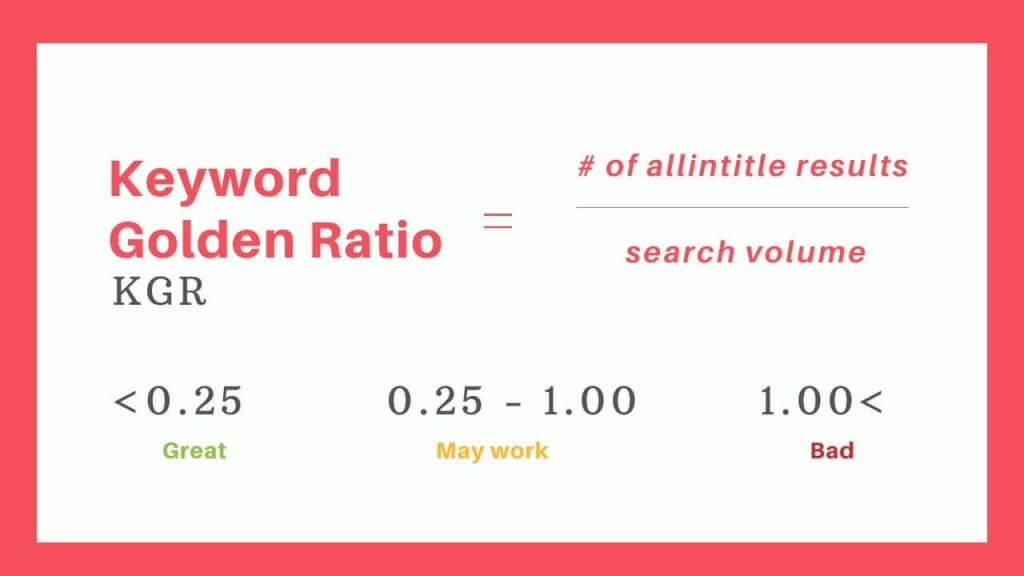
KGR = Number of Google “allintitle” results ÷ Monthly search volume
The “allintitle” search shows how many web pages include the exact keyword phrase in their title. Comparing this number with the keyword’s monthly search volume helps you estimate how difficult it may be to rank for that keyword.
Understanding KGR Scores
KGR scores are generally divided into three categories:
- Below 0.25: These keywords have very low competition and are considered the best opportunities. They are ideal for new websites because they offer a higher chance of ranking quickly when supported by high-quality content.
- 0.25 to 1.00: These keywords have moderate competition. They can still be worthwhile, but ranking may require stronger content, better on-page SEO, and a website with growing authority.
- Above 1.00: These keywords are highly competitive. Ranking for them is usually more challenging because many websites are already targeting the same search terms. Success often requires exceptional content, quality backlinks, and a well-established domain.
Although KGR is a valuable framework for finding low-competition keywords, it shouldn’t be your only SEO strategy. Consider factors such as search intent, content quality, topical authority, and user experience to maximize your chances of achieving long-term rankings in Google.

For the best results, many SEO professionals recommend starting with keywords that have a Keyword Golden Ratio (KGR) below 0.25. These keywords typically face less competition, making them easier for newer websites to target. Test the strategy across multiple articles, monitor your rankings, and refine your keyword selection based on real performance.
Benefits of Using the Keyword Golden Ratio (KGR)
The Keyword Golden Ratio offers several advantages, particularly for new websites and niche blogs looking to build organic traffic.
Improve Rankings Faster
Low-competition keywords often have a better chance of ranking than highly competitive search terms. When you combine KGR keywords with helpful, well-optimized content, your pages may begin appearing in Google’s search results much sooner than if you target broad, competitive keywords.
While some websites see improvements within days, ranking speed depends on factors such as your site’s authority, content quality, and Google’s indexing process.
Narrow Down Thousands of Keyword Ideas
Finding the right keyword can be overwhelming when there are thousands of possible topics. KGR helps you filter those ideas into a shortlist of realistic opportunities, allowing you to focus your time on content with a higher chance of success. As search trends evolve, you can repeat the process to discover fresh keyword opportunities.
Prioritize Content That Matches Search Demand
Successful SEO isn’t just about finding low-competition keywords, it also requires understanding what users are looking for. KGR encourages you to create content that aligns with genuine search intent, helping you publish articles that are both useful and relevant to your audience.
Increase Revenue Opportunities
More organic traffic can create additional earning opportunities through Google AdSense, affiliate marketing, lead generation, or product sales. Although KGR doesn’t guarantee higher earnings, attracting targeted visitors gives your website a stronger foundation for monetization.
Drive More Organic Traffic
Publishing content around carefully selected low-competition keywords can improve your visibility in search engines. As more of your pages rank, your website can attract a steady stream of organic visitors without relying solely on paid advertising.
Ideal for New Websites
One of KGR’s biggest strengths is that it gives newer websites a realistic opportunity to compete. Early ranking success can build confidence, increase website traffic, and motivate you to continue producing valuable content.
Reduce Dependence on Backlinks
While backlinks remain an important Google ranking factor, KGR allows you to compete in less competitive search spaces where fewer backlinks may be needed. Creating high-quality, informative content can often help you rank before investing heavily in link-building campaigns.
Lower Advertising Costs
Ranking organically for relevant keywords can reduce your reliance on paid advertising. Although many businesses still use Google Ads to accelerate growth, a strong SEO strategy can generate consistent traffic over the long term without ongoing ad spend.
Build Unique Topical Authority
Since KGR encourages in-depth keyword research, you’ll often uncover topics that competitors have overlooked. Publishing valuable and original content around these opportunities helps establish your website as a trusted source within your niche.
Start Generating Returns Earlier
As your pages gain visibility and attract more visitors, you can begin monetizing your website through ads, affiliate partnerships, digital products, or services. While results vary from one website to another, KGR can help you build momentum faster than targeting highly competitive keywords from the beginning.
How to Use the Keyword Golden Ratio (KGR)
Using the Keyword Golden Ratio is a straightforward process. The goal is to find low-competition keywords that have a realistic chance of ranking, especially if your website is new or has limited authority.
Step 1: Choose Your Niche and Content Topic
Start by identifying the niche you want to focus on. Your content should align with your website’s purpose, your audience’s interests, and your expertise.
Brainstorm topics that:
- Solve your audience’s problems.
- Complement your existing content.
- Fill gaps that competitors haven’t covered.
- Match current search trends within your niche.
Having a clear content strategy before researching keywords will help you create more valuable and relevant articles.

Step 2: Find Low-Competition Keywords
Once you’ve selected a topic, begin researching keywords with a low Keyword Golden Ratio. Ideally, look for keywords with a KGR score below 0.25, as these generally have the least competition.
You can refine your keyword research using filters such as:
- Monthly search volume
- Keyword difficulty
- Cost per click (CPC)
- Search intent
- Long-tail keyword variations
- Related keyword suggestions
Popular keyword research tools include:
- Google Keyword Planner
- Ahrefs
- Semrush
- BuzzSumo
- Ubersuggest
These tools help you discover keywords that are both relevant to your niche and achievable for your website.
Step 3: Analyze the Competition
Before creating your content, study the pages that already rank for your chosen keyword.
Ask yourself:
- What information do they provide?
- Are there gaps you can fill?
- Can you create a more detailed, helpful, or up-to-date resource?
Your objective isn’t to copy existing content but to publish something more valuable and useful for readers.
Step 4: Calculate the Keyword Golden Ratio
Next, determine the keyword’s KGR score. Go to Google and search using the following format:
allintitle keyword
For example:
allintitle SEO tools for startups
Google will display the number of pages that contain the exact keyword phrase in their title.
Then use the KGR formula:
KGR = Number of “allintitle” results ÷ Monthly search volume
Step 5: Evaluate the Result
Once you’ve calculated the ratio, use these general guidelines:
- Below 0.25: Excellent opportunity. These keywords usually have low competition and are ideal for newer websites.
- 0.25–1.00: Moderate competition. These keywords can still be worthwhile if you create comprehensive, high-quality content.
- Above 1.00: High competition. Ranking for these keywords is generally more difficult and may require stronger domain authority, backlinks, and exceptional content.
Remember that KGR should be one part of your overall SEO strategy. Always consider search intent, content quality, user experience, and topical authority alongside keyword competition. Combining these factors will give your content the best chance of earning sustainable rankings in Google.
What Is the allintitle Search Operator?
allintitle is an advanced Google search operator that shows how many web pages contain your exact keyword or phrase in their page title. It is a valuable SEO technique used to estimate how many pages are directly targeting a specific keyword.
To use it, simply type the following into the Google search bar:
allintitle keyword
For example:
allintitle keyword research tools
Google will display the pages that include that exact phrase in their title and show the total number of matching results. This number is commonly used when calculating the Keyword Golden Ratio (KGR) to estimate keyword competition.
The allintitle search operator also allows you to analyze competing pages. By reviewing the top-ranking content, you can identify what topics they cover, spot content gaps, and create a more comprehensive, informative, and valuable article for your audience.
When using the allintitle operator, type it directly before your keyword without adding extra spaces after the colon. You can use quotation marks if you want Google to search for the exact phrase, although many KGR practitioners use the operator without quotes depending on their research method. The key is to use the same approach consistently when comparing keywords.

How Long-Tail Keywords Can Benefit Your SEO
Long-tail keywords are longer and more specific search phrases that usually have lower competition than broad keywords. While they often receive fewer searches, they tend to attract visitors who know exactly what they’re looking for.
For example, consider the keyword:
- Movies – Extremely broad and highly competitive.
- Trending movies – More specific, but still competitive.
- Best trending movies of 2026 – Much more targeted and easier to rank for.
Someone searching for “best trending movies of 2026” has a clear intent. If your content directly answers that query, your page has a better chance of appearing in search results and attracting highly relevant visitors.
Although long-tail keywords typically have lower search volumes, they often deliver higher-quality traffic because they closely match what users want. This makes them an excellent choice for new websites and niche blogs.
Common Limitations of the Keyword Golden Ratio (KGR)
Like any SEO strategy, the Keyword Golden Ratio has its strengths and limitations. Understanding these will help you use it more effectively.
Avoid Keyword Overuse
Using your target keyword naturally is important, but repeating it excessively can hurt readability and create a poor user experience.
Instead of focusing on keyword density, write naturally and include related terms where they make sense. Google’s algorithms are sophisticated enough to understand context, so your priority should always be creating helpful content rather than forcing keywords into every paragraph.
Low Competition Doesn’t Always Mean High Demand
Some keywords have little or no competition simply because very few people search for them. Before targeting a keyword, make sure it has genuine search demand and aligns with your audience’s interests. Publishing content for a keyword that nobody searches for is unlikely to generate meaningful traffic.
Keyword Research Requires Skill
Finding valuable KGR opportunities takes practice. You need to balance search volume, competition, search intent, and relevance to your niche. Popular keyword research tools include:
- Google Keyword Planner
- Ahrefs
- Semrush
- BuzzSumo
- Ubersuggest
Using multiple tools often provides a more complete picture of keyword opportunities.
KGR Is Not a One-Time Strategy
Publishing a single KGR-optimized article is unlikely to transform your website overnight. SEO is a long-term process. Consistently publishing high-quality content around carefully researched keywords builds topical authority and improves your chances of earning sustainable rankings over time. Think of your website like a garden, you won’t see results immediately after planting the seeds, but with consistent care, it will continue to grow.
Long-Tail Keywords Can Still Be Competitive
Although long-tail keywords are generally easier to rank for, that’s not always the case. Some long-tail phrases receive significant search volume and attract strong competition from authoritative websites. In these situations, you’ll need exceptional content, strong on-page SEO, and a positive user experience to compete successfully.
What If a KGR Keyword Has High Search Volume?
Occasionally, you may discover a keyword with a KGR below 0.25 that also has relatively high search volume. These opportunities are uncommon but can be valuable.
When you find one:
- Create the most comprehensive and helpful content possible.
- Match the user’s search intent.
- Optimize your title, headings, images, and internal links.
- Keep the content updated as new information becomes available.
Even if competition increases over time, high-quality content gives you a better chance of earning and maintaining strong rankings.
Conclusion
The Keyword Golden Ratio is a useful keyword research framework, especially for new websites looking to identify low-competition opportunities. Rather than chasing highly competitive keywords, KGR encourages you to focus on search terms where you have a realistic chance of ranking.
For the best results, build a content plan around multiple KGR-friendly keywords instead of relying on a single article. Publishing 20–30 well-researched, high-quality posts can help establish your website’s topical authority and steadily increase organic traffic.
However, remember that keywords alone don’t guarantee success. Google rewards content that is accurate, helpful, trustworthy, and genuinely valuable to users. Understanding search intent, answering readers’ questions, and providing a great user experience are just as important as choosing the right keywords.
Use the Keyword Golden Ratio as one part of your overall SEO strategy, combine it with excellent content, and stay consistent. Over time, this approach can help your website attract targeted traffic, improve search visibility, and build long-term organic growth.