seolounge
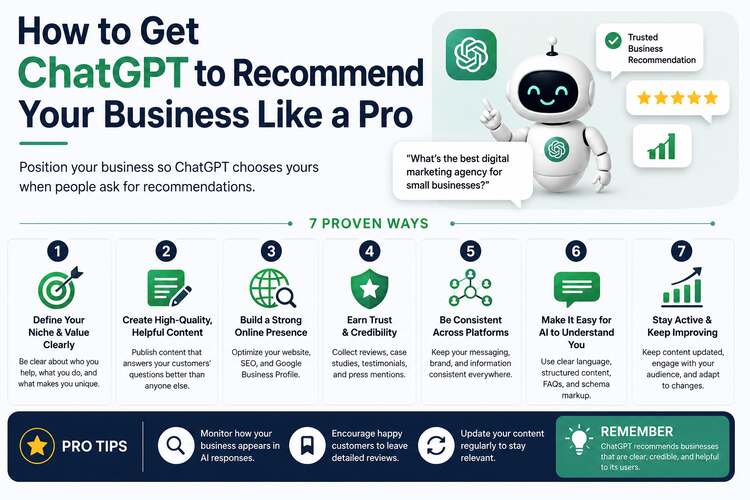
Getting found online is changing fast. Traditional seo still matters, but ai search is now shaping how people discover brands, compare options, and make decisions. That means ChatGPT recommendations can influence trust before someone even clicks a website. If your business is not showing up in AI answers, you may be missing early buying moments. The good news is that you do not need luck. You need the right signals, steady visibility, and a smart approach that fits this new search environment.
“How to Get ChatGPT to Recommend Your Business Like a Pro” explores practical ways to improve your brand’s visibility in AI-powered search. Instead of focusing only on traditional keyword rankings, the guide explains how to understand buyer prompts, create AI-friendly content, strengthen local SEO, optimize your Google Business Profile, build credible citations, earn genuine reviews and mentions, and establish a stronger online reputation. The goal is simple: make your business easier for AI systems to understand, trust, and confidently recommend when potential customers are looking for the services you offer.
Understanding ChatGPT Recommendations for Businesses
ChatGPT recommendations are shaped by patterns found across the open web. Large language models notice which brands appear repeatedly in reliable sources, industry forums, blog posts, and news coverage. When your name shows up often in useful contexts, you become easier to surface in ai answers and ai search results.
So how do you improve your odds? Answer engine optimization focuses on building those trust signals. That means stronger mentions, clearer positioning, and a wider digital footprint. The next sections break down how AI tools make those choices and what your business can do.
How AI Tools Choose Which Businesses to Suggest
AI search engines do not work like a basic search engine that only lists blue links. They generate summaries and often present a short list of brands. When your company’s name appears in those answers, it can feel like an implied endorsement to the reader, even if no ad was involved.
In simple terms, generative engine optimization is about helping AI connect your business with real topics, questions, and expertise. These systems tend to notice repeated mentions across credible places instead of relying on one signal alone.
Key factors often include:
- Repeated mentions of your company’s name across reliable sources
- Coverage in blog posts, industry forums, or news stories
- Consistent positioning that helps AI search engines categorize what you do
- Clear associations between your brand and the questions people ask
The Role of Online Presence in ChatGPT’s Recommendation Process
Your online presence plays a central role in whether AI can recognize and suggest your business. Traditional seo still helps because stronger seo rankings can lead to more visibility, more mentions, and more chances for your brand to appear in search results across the web.
At the same time, AI looks beyond your own site. Your brand’s digital footprint includes social platforms, forums, regional articles, and other places where people discuss your business. When those signals align, AI has an easier time understanding who you are and why you matter.
That is why consistency matters so much. If your website says one thing but your outside profiles are vague, AI may struggle to connect the dots. Better visibility can support both online traffic and stronger recommendation potential.
What You Need to Get Started
Before you chase ai search visibility, start with the basics. Your business name, category, services, and public descriptions should be easy to find and consistent across important platforms. AI works better when your core details are clear and repeated in the same way.
This matters for local firms and online retailers alike. The company’s research shared in the source material points to stronger outcomes for brands that earn mentions across multiple places. Next, let’s look at the resources and listings that support better discovery.
Why AI Recommendations Drive High-Value Leads
Over the past year, my team and I have run more than 200 experiments to understand how AI visibility impacts businesses. We worked with clients across the home services industry, including HVAC, plumbing, roofing, electrical, landscaping, and other local services.
One thing became clear: being recommended by AI can put your business in front of highly motivated prospects at exactly the right moment. Here are some of the trends we’ve seen:
- AI leads can move faster. When an AI tool recommends a short list of businesses, people often view those recommendations as more relevant and trustworthy than scrolling through dozens of traditional search results.
- Higher conversion potential. Research from Ahrefs found that AI-driven referral traffic can convert at significantly higher rates than traditional search traffic. Ahrefs research
- Trust in AI recommendations is growing. According to Bloomreach, 46% of consumers say they trust AI-generated recommendations as much as, or more than, recommendations from friends. Bloomreach research
- Millennials are an important audience. Millennials are among the more active users of AI tools and represent a significant share of home improvement spending. That makes AI visibility increasingly important for businesses looking to reach future customers.
- AI summaries are shaping search decisions. Bain & Company reports that around 80% of search users rely on AI-generated summaries for at least 40% of their search decisions. Bain & Company research
- AI-powered search is becoming more mainstream. Gartner has predicted a significant shift in traditional search activity as consumers increasingly turn to AI chatbots and virtual agents. Gartner research
This is a new frontier for digital marketing. The question businesses should be asking now isn’t just, “How do I rank on Google?” It’s also:
“How do I get recommended by ChatGPT, Gemini, Perplexity, and other AI platforms?”
That’s where an increasing number of potential customers are looking for answers, recommendations, and businesses they can trust. And much like traditional SEO in its early days, businesses that start building AI visibility now have an opportunity to gain an advantage that can grow over time.
The 80/20 Rule of AI Visibility
One question I hear quite often is:
“If AI search is becoming so important, am I wasting money on SEO?”
The short answer is no. SEO is still incredibly important, in fact, it may be more important than ever. AI platforms don’t simply create recommendations out of thin air. They use information from across the web to understand businesses, products, services, expertise, reputation, and relevance.
That information can come from sources such as:
- Google search results – Well-optimized, relevant, and trustworthy content can help AI systems understand your brand.
- Review platforms – Google reviews, Yelp, Healthgrades, Avvo, and other trusted platforms can contribute to your online reputation.
- Authoritative directories – Industry-specific directories, local listings, citations, and other credible sources help establish your business’s presence and authority.
So, if your business is difficult to find in traditional search, there’s a good chance it will also struggle to appear in AI-generated recommendations. Think of traditional SEO as the 80% foundation. It helps establish your website’s authority, relevance, credibility, and overall online presence. Then comes GEO (Generative Engine Optimization), the additional 20% focused on making your brand easier for AI systems to understand, trust, and potentially recommend.
In simple terms, SEO helps you get discovered, while GEO helps position your business to be included in AI-generated answers and recommendations. The opportunity is still relatively new, which means businesses that start adapting now have plenty of room to build an advantage. So, how exactly do you make your brand more likely to be recommended by AI systems? Let’s take a closer look.
| Traditional vs. AI-Driven Approaches | ||
| Criteria | Traditional SEO | AI SEO (for ChatGPT, Gemini, etc.) |
| Goal | Rank on Google/Bing search results | Get mentioned or recommended by AI tools |
| Optimization Focus | Keywords, backlinks, technical SEO | Authority, clarity, structured content, and reputation |
| Content Tone | Keyword-rich, sometimes technical | Conversational, helpful, user-focused |
| Discovery Method | Crawlers/indexing of webpages | Pre-trained knowledge + live data integrations |
| Reviews/Reputation | Helpful but not always a direct ranking factor | Strong influence on AI recommendations |
| Structured Data | Boosts rich snippets | Helps AIs |
Tools like ChatGPT have quickly become part of everyday life, changing the way people search for information, compare options, solve problems, and even find businesses. So if you’re wondering how to get your business mentioned when someone asks ChatGPT for a recommendation, you’re asking the right question.
And here’s the good news: there’s no secret trick or magic formula. It comes down to building the right online presence and sending the right signals.
In this guide, we’ll look at how ChatGPT and other AI-powered tools can evaluate businesses, what can influence their recommendations, and what you can do to make your brand easier to discover and understand. From creating useful website content and strengthening local SEO to earning genuine reviews and building a solid reputation, these strategies can help your business compete in an increasingly AI-driven search landscape.
Understanding How ChatGPT Makes Recommendations
Before trying to improve your visibility, it helps to understand how AI recommendations work.
Traditional search engines primarily organize results around factors such as keywords, relevance, authority, and rankings. ChatGPT, on the other hand, responds conversationally and can draw on its available knowledge and, in supported experiences, information retrieved from external sources.
While there isn’t a single public checklist that guarantees a business will be recommended, several factors can make a business easier for AI systems to understand and reference:
- Quality and credibility: Keep your business information accurate, useful, and consistent across the web. Clear and trustworthy information gives AI more context about who you are and what you offer.
- Search visibility: Strong SEO can contribute to your overall online presence. Businesses that consistently appear across relevant search results and trusted websites are easier to discover and understand.
- Reputation and reviews: Positive customer reviews, testimonials, and credible online mentions can strengthen your reputation and provide additional signals about the quality of your business.
There’s another important difference to remember: AI search is conversational.
People don’t always ask AI using short keywords. They ask complete questions, explain their situation, and expect an answer that actually helps them make a decision.
Think about the difference between:
“Best plumber in Ahmedabad”
and
“My kitchen pipe is leaking. Which plumber in Ahmedabad is reliable and available for emergency repairs?”
The second question provides much more context. Your online presence should make it easy for AI systems—and potential customers—to understand exactly what your business does, where you operate, and why someone should consider choosing you.
How AI Evaluates Trust: Signals That Matter
So, what makes a business look trustworthy to AI?
AI doesn’t “trust” a business in the same way a person does. Instead, it can rely on information and signals from different sources to understand whether a company appears credible, relevant, and established.
Here are some of the signals worth paying attention to:
- Keep Your Business Information Consistent: Make sure your business name, address, phone number, website, and other core details are accurate and consistent across your website, directories, social profiles, and other platforms. Conflicting information can create confusion for both customers and AI systems.
- Keep Your Content Fresh: Regularly review and update important pages, service information, FAQs, and other useful content. An active website gives visitors and search systems a clearer picture of your current business.
- Earn Mentions from Reputable Websites: Coverage from respected industry publications, local news websites, partners, and relevant blogs can strengthen your online authority and give AI additional sources of information about your business.
- Build Positive Online Conversations: Reviews, testimonials, customer experiences, and relevant discussions on platforms such as Reddit and Quora can contribute to your broader online reputation. The focus should always be on genuine participation rather than manufactured mentions.
- Earn High-Quality Backlinks: Links from authoritative and relevant websites can support your SEO and reinforce your credibility within your industry. A handful of relevant, trustworthy links is far more valuable than collecting random links simply for the sake of quantity.
Getting recommended by AI isn’t about finding a shortcut or trying to “hack” ChatGPT. It’s about building a business that is easy to understand, easy to verify, and consistently presented as credible across the web.
Keep your information accurate. Publish genuinely useful content. Maintain a strong local presence. Earn authentic reviews and mentions. Build relationships with reputable websites. And most importantly, give customers a real reason to recommend you.
When your business consistently demonstrates expertise and credibility online, you’re not just improving your chances of being noticed by AI, you’re building a stronger digital presence for real customers, too.
Essential Resources for Optimizing Your Business Visibility
If you want the best way to improve visibility, focus on resources that strengthen trust and consistency. A complete Google Business Profile is a smart starting point for local seo, while your website and public mentions help support broader discovery.
You also need systems for tracking where your company’s name appears. The source material points to tools like Google Alerts and Brand24 for monitoring mentions. That helps you spot momentum, fix gaps, and stay aligned across channels. Useful resources include:
- Google Business Profile for stronger local seo and clear business details
- Mention tracking tools to monitor where your company’s name shows up
- Website updates and public content that support seo rankings and category clarity
These pieces work together. They help search systems and AI understand what your business does and where it fits.
Must-Have Information and Listings for Effective Recommendations
Think of your listings as your public identity. If your business name, services, and positioning are incomplete or scattered, AI may skip you when building a short list of brands for a user. Clear, repeated details improve your online presence and make recognition easier. It also helps to appear in independent places. News coverage, directory profiles, and relevant discussions give AI more context than your own site alone. That wider trail matters as search behaviour shifts beyond any single google feature.
| Information Type | Why It Matters for AI Recommendations |
| Business name | Helps AI match mentions across platforms and sources |
| Core services or products | Clarifies what questions your business can answer |
| Location or service area | Supports local discovery and relevant suggestions |
| Directory listings | Adds structured, public business information |
| News coverage | Builds credibility through independent references |
| Consistent descriptions | Improves recognition across your online presence |
Make sure these details stay accurate everywhere they appear.
Step-by-Step Guide to Getting Your Business Recommended by ChatGPT
You do not need a complicated system to improve your ai search presence. What matters most is building trust signals that help AI connect your company’s name with relevant topics, expertise, and customer intent. That is the heart of answer engine optimization.
The source material highlights practical ways to earn those signals: stronger website content, accurate directory profiles, visible customer feedback, and consistent brand details across channels. Let’s walk through each step so you can turn ideas into action.
Step 1: Enhance Your Business Website with Relevant Keywords
Your website is still a major starting point. Clear language on service pages and product pages helps search systems understand what your business offers. That supports seo rankings and gives AI better context when a practical question matches your expertise.
Keywords help when they reflect real customer intent. The source material also points to original data and small surveys as useful assets. When your website publishes something worth quoting, other sites may mention it, and that can strengthen generative engine optimization over time.
Focus on website improvements such as:
- Clear page titles and copy that match what customers search for
- Product pages or service pages that explain exactly what you do
- Original data, findings, or case studies that others may reference
The goal is not stuffing terms everywhere. It is making your site easier for both people and AI to understand.
Step 2: Optimize Your Profiles on Popular Online Directories
Directory profiles give AI and search engine systems structured facts about your business. If your Google Business Profile and other business listings are complete, they create consistent visibility across the web. That makes it easier for systems to verify who you are.
Accurate information is the key here. If your name, category, or contact details vary from one platform to another, recognition becomes harder. Clean, matching listings support trust and reduce confusion. Prioritize these actions:
- Claim and complete your Google Business Profile with accurate information
- Review your business listings so your main details match everywhere
This step is simple, but it matters. Popular directories often act like public confirmation points for your business identity.
Step 3: Gather and Showcase Authentic Customer Reviews
Customer feedback does more than persuade buyers. Authentic customer reviews add public proof that your business serves real people. When your company’s name appears in review platforms and public discussions, it can support trust and visibility beyond your own messaging.
This can affect buyer behavior in a meaningful way. The source material notes that brands with broader mentions across platforms saw stronger conversion rates. Reviews also help answer real customer questions by showing what people value, what problems you solve, and why others chose you. Ways to strengthen this area include:
- Ask satisfied customers to leave authentic customer reviews on trusted platforms
- Highlight reviews that reflect common customer concerns and outcomes
- Keep review responses professional so your public presence feels credible
When people see repeated positive signals, the implied endorsement effect becomes stronger.
Step 4: Keep Your Business Details Up-to-Date Across Platforms
One of the easiest mistakes to make is letting your business details drift across channels. Old descriptions, mixed positioning, or incomplete profiles can weaken consistent visibility. If AI sees conflicting signals, it may not know how to categorize your business or when to show it.
That is why regular updates matter. Refresh your website, review your social platforms, and make sure the same core message appears everywhere. This can support search rankings, improve online traffic, and make your brand easier to understand across the open web.
You should also monitor mentions over time. Tools like Google Alerts help you track where your name appears and whether the context fits your brand. Small fixes made consistently can strengthen recognition more than one big change.
Key Highlights
- ChatGPT recommendations often favor businesses with strong brand mentions across the open web.
- AI search rewards clear, consistent online presence more than one-time promotion tactics.
- Better business visibility comes from trusted coverage, community activity, and accurate listings.
- Answer engine optimization builds trust signals that help your business name appear in AI answers.
- Brand mentions in news, forums, and blogs can influence how AI search results surface companies.
- Strong profiles, reviews, and website updates improve your odds of future chatgpt recommendations.
How to Get Your Business Recommended by AI: A 10-Step Roadmap
AI search is changing the way customers discover local businesses. Instead of typing a few keywords into Google and browsing through pages of results, people are increasingly asking AI tools complete questions and expecting a shortlist of businesses that fit their needs.
That means your goal shouldn’t simply be to rank for keywords. You also need to make your business easy for AI systems to understand, trust, and recommend. Here are practical steps to help improve your AI visibility.
Step 1: Map Your Buyer Prompts
One of the biggest changes in AI search is the move from keywords to questions and real-world problems. For example:
- Keyword: “HVAC repair Dallas”
- AI prompt: “My AC is blowing warm air. Which Dallas HVAC company has the best reviews?”
The second query tells you much more about what the customer actually wants. They’re not simply looking for an HVAC company—they need a solution and want to know who they can trust. To build a useful prompt list for your business:
- Talk to your sales team about the questions and concerns customers raise before booking.
- Ask existing customers what they searched for before choosing your company.
- Focus on high-intent situations such as emergency repairs, pricing, availability, comparisons, and trust.
- Create a list of around 30–50 realistic prompts connected to strong buying intent.
These questions can become the foundation of your AI-focused content strategy.
Step 2: Audit Where You Stand
Once you have your list of buyer prompts, it’s time to see how AI currently views your business. Run those prompts through platforms such as ChatGPT, Gemini, Perplexity, and other relevant AI tools. Then look closely at the results. Ask yourself:
- Does my business appear in the recommendations?
- If not, which competitors are being mentioned?
- Which websites, directories, review platforms, or other sources are being cited?
This gives you a starting point. More importantly, it shows you what AI already considers relevant and trustworthy in your market.
Step 3: Make Your Website AI-Ready
AI systems need clear, useful, well-organized information to understand your business. A confusing or outdated website makes that job much harder. Start by making your pages easier for both people and AI systems to understand.
Lead With the Answer
Don’t make visitors dig through several paragraphs to find the information they need. Use a BLUF (Bottom Line Up Front) approach and place the key answer near the beginning of the page.
Publish Useful, Original Content
Create content that genuinely answers customer questions. Avoid thin, repetitive pages that add little value.
Structure Your Content Clearly
Break your content into logical sections, headings, lists, and topic clusters. A well-organized page is easier for visitors to scan and easier for AI systems to interpret.
Add FAQs
FAQs are an excellent way to answer the specific questions your customers are already asking. They also give you opportunities to address pricing, timelines, services, processes, and common concerns.
Use Video
Short, useful videos can demonstrate your expertise and answer common customer questions. Adding transcripts gives search and AI systems additional text they can understand.
Include Tables and Comparisons
If your customers regularly compare prices, warranties, service options, timelines, or packages, make that information easy to scan.
Optimize Images
Use descriptive alt text and appropriate structured data for important images, especially project galleries and before-and-after photos.
Add Detailed Structured Data
Use relevant structured data to help search engines and AI systems understand important information about your business, services, content, authorship, dates, ratings, and other details.
And don’t forget about freshness. AI search is increasingly influenced by current information, so regularly reviewing and updating important content should be part of your ongoing strategy.
Step 4: Master Local SEO
If you run a local business, this step is critical. Imagine a potential customer asking an AI assistant:
“Who is the best electrician in my city?”
Would your business appear?
If the answer is no, your local SEO may need attention.
AI systems use a range of local signals when evaluating businesses. That makes your reviews, location information, directory listings, and overall local presence increasingly important. Focus on:
- Building a strong review profile: Consistent positive reviews can strengthen your reputation.
- Using location-specific language: Instead of simply saying “roofer,” make your service and location clear, such as “roof replacement contractor in Tampa.”
- Building relevant directory listings: Maintain accurate profiles on trusted platforms and industry-specific directories.
Strong local SEO doesn’t just help you appear in traditional search. It can also give AI systems more information about who you are, what you do, and where you operate.
Step 5: Optimize Your Google Business Profile
For local businesses, your Google Business Profile is one of the most important pieces of your online presence. It provides customers with essential information such as your reviews, phone number, photos, business hours, and services. Make sure your profile is complete and regularly maintained. Here are some practical things to do:
- Complete every relevant section of your profile.
- Select the most accurate business categories.
- Upload authentic photos from real projects and jobsites.
- Keep your phone number, business hours, and service areas current.
- Consistently encourage genuine customer reviews.
- Respond professionally to both positive and negative reviews.
- Publish useful updates, promotions, and seasonal content.
The source recommends aiming for at least five new reviews each month, although the number you’ll need can vary significantly depending on your industry and local competition. The bigger takeaway is consistency. A profile that is accurate, active, and backed by genuine customer feedback gives your business a much stronger local presence.
Step 6: Build Your Citation Network
Think of online citations as references to your business across the web. These typically include your business name, address, and phone number, along with other relevant business information. The goal isn’t to collect hundreds of random listings. It’s to build a network of relevant and credible mentions that reinforce your business’s legitimacy. Consider opportunities such as:
- High-authority directories: Depending on your industry, this could include Houzz, Angi, Thumbtack, HomeAdvisor, Porch, Yelp, BBB, local contractor directories, and trade associations.
- “Best of” lists: Look for relevant local roundups and industry lists, such as “Best HVAC Companies in Chicago.”
- Knowledge bases: Platforms such as Wikipedia can be powerful authority signals, although they are difficult to earn inclusion in and should never be approached through artificial promotion.
A simple way to identify useful citation opportunities is to search your most important keywords and see which directories and websites consistently appear. If your competitors are listed there and you’re not, that’s a potential gap worth investigating.
Step 7: Leverage Forums and Communities
AI systems can draw information from conversations happening across forums, communities, and other online platforms. That makes places such as Reddit, Quora, and relevant niche communities worth paying attention to. But there’s an important distinction here: don’t try to manufacture mentions. Spammy comments, fake accounts, and promotional posts are unlikely to build genuine trust. Instead:
- Share genuinely useful information in communities where your customers spend time.
- Answer real questions with detailed, practical advice.
- Participate in conversations where your expertise is actually relevant.
- Encourage satisfied customers to share their experiences organically.
This approach takes more effort than running an advertisement, but authentic conversations can contribute to a stronger reputation and a more credible online presence.
Step 8: Use Digital PR to Build AI Visibility
Digital PR can be another valuable way to strengthen your online authority. AI systems value information from credible sources, and news coverage can provide an additional layer of recognition and context around your business. Look for stories that are genuinely worth covering, such as:
- A new service or major hire: Turn meaningful business developments into newsworthy stories.
- Community involvement: Sponsor or participate in local events and share your involvement with relevant media.
- Expert commentary: Provide useful data, insights, or expert opinions that journalists can reference.
The goal isn’t simply to get your company name published somewhere. It’s to earn credible, relevant mentions that strengthen your authority and give AI systems more trustworthy information about your business.
Step 9: Strengthen Your Trust Footprint
AI recommendations depend heavily on the information available about your business. If your online presence consistently communicates credibility, expertise, and customer satisfaction, you’re giving AI systems stronger signals to work with. Build your trust footprint by:
- Generating genuine customer reviews: Keep asking satisfied customers for feedback and maintain a consistent flow of new reviews.
- Earning media mentions: Look for opportunities in local news, industry publications, and credible websites.
- Showing trust signals on your website: Clearly communicate relevant credentials such as licensing, bonding, insurance, warranties, and professional qualifications.
- Getting involved in your industry: Participate in respected associations, events, and professional communities.
Remember, AI systems can pull information from many different sources. Your website is only one part of the picture. Reviews, news articles, directories, forums, and social profiles can all contribute to the overall impression of your business.
Step 10: Track, Measure, and Improve
You’ve mapped your prompts, improved your website, built citations, strengthened your local presence, and worked on your reputation. Now comes the part many businesses overlook:
Measure the results.
You can’t improve an AI visibility strategy if you don’t know whether it’s actually working. Here are a few practical ways to track progress:
- Ask customers directly: Add “How did you hear about us?” to your forms or feedback process and include AI tools as an option.
- Check your target prompts regularly: Run your most important prompts each month and record whether your business appears and which competitors are mentioned.
- Monitor citations: Pay attention to which websites AI systems reference when discussing your industry or location.
- Improve based on what you find: If your business appears but isn’t being cited, strengthen your content with clearer FAQs, structured information, tables, and authoritative references. If you’re being cited but rarely recommended, look for opportunities to improve the depth, relevance, and authority of your content.
You can also use tools such as Google Search Console to monitor relevant search performance and identify areas that need improvement.
The key is to treat AI visibility as an ongoing process, not a one-time SEO project. Track what happens. Find the gaps. Make improvements. Test again. That’s how you turn AI search visibility into a long-term digital marketing advantage.
Few Other Considerable Points To Get Cited in AI Overviews
Enhancing Your Online Reputation
Your website isn’t the only thing AI systems can use to understand your business. They can also encounter information about your brand through reviews, articles, directories, social platforms, and conversations happening across the web.
That means your overall online reputation matters. The more consistently your business is represented as reliable and trustworthy, the stronger your digital presence becomes.
Collect and Showcase Genuine Reviews
Encourage satisfied customers to share their honest experiences on platforms such as Google, Yelp, and relevant industry-specific review sites.
Don’t stop at collecting reviews, either. Take the time to respond to them—both positive and negative. A thoughtful response shows that you’re paying attention, value customer feedback, and are willing to stand behind your service.
Highlight Testimonials and Case Studies
Real customer experiences can be some of your most convincing marketing assets. Share testimonials, project results, and case studies that show how your product or service helped solve a genuine problem. Specific examples give potential customers—and AI systems, more context about what your business actually does well.
Build Social Proof
Being mentioned by respected websites, publications, industry blogs, or relevant influencers can strengthen your credibility. Start building relationships with journalists, publishers, bloggers, and other trusted voices in your industry. The goal isn’t to collect random mentions; it’s to earn relevant and credible recognition.
Creating AI-Friendly Content
If you want your business to be easier for AI systems to understand, your content needs to be clear, useful, and aligned with the way people actually ask questions.
Make FAQs a Priority
A well-written FAQ section can answer the questions customers ask before making a decision. Instead of filling it with generic questions, focus on real concerns and use natural, conversational wording. For example:
“What’s the best Italian restaurant near me for a family dinner?”
This type of question is much closer to how people interact with AI assistants than a simple keyword such as “Italian restaurant.”
Create Evergreen Content
Not every piece of content needs to chase the latest trend. Build useful resources that can continue attracting visitors over time, such as how-to guides, industry tips, checklists, tutorials, comparison guides, and helpful resource pages. Good evergreen content can continue delivering value long after the original publication date.
Keep Your Writing Conversational and Clear
Write the way you would explain something to a customer, but keep it professional. Avoid unnecessary jargon, complicated sentences, and overly technical language when a simpler explanation will do. Your content should be easy for a real person to understand and easy for AI systems to interpret.
Establishing Authority in Your Niche
If you want your business to become a trusted recommendation, you need to demonstrate why you’re qualified to provide the service.
Highlight What Makes You Different
Don’t try to sound like every other business in your industry. Focus on your specific strengths, experience, services, specialties, or areas of expertise. If you have something that genuinely sets you apart, make it clear throughout your website and other online profiles.
Collaborate With Trusted Partners
Working with respected organizations, experts, and businesses in your industry can help strengthen your credibility. Consider opportunities such as guest contributions, partnerships, webinars, interviews, joint events, or other collaborations where you can demonstrate your expertise to a relevant audience.
Be Active Where Your Customers Spend Time
Don’t limit your presence to your own website. Look for reputable directories, industry forums, professional communities, and other platforms where your target audience is already active. Participate naturally, answer questions, and share useful insights rather than constantly promoting your business. The goal is to become a helpful voice in your industry, not just another company trying to sell something.
Measuring Your Success
Improving AI visibility isn’t a one-time task. You need to monitor what’s working, identify gaps, and adjust your strategy over time. Here are a few areas worth tracking:
- SEO Performance: Use tools such as Google Analytics to monitor website traffic, engagement, and other important performance indicators.
- Online Mentions: Tools such as BuzzSumo can help you discover where your brand is being mentioned and what people are saying about it.
- Customer Feedback: Reviews, surveys, testimonials, and direct customer feedback can reveal what’s working well and where your business experience could improve.
Don’t focus only on vanity metrics. Look for signals that connect your digital activity to visibility, trust, qualified leads, and actual business results.
The Future of AI Recommendations
AI is becoming a bigger part of how people discover information and evaluate their options. As these tools continue to evolve, businesses will need to keep improving the quality of their content, reputation, and overall digital presence. The businesses that adapt early can put themselves in a stronger position as AI-powered discovery becomes more common.
What’s Next?
Focus your efforts on three key areas:
- Content Marketing: Continue publishing useful, original, high-quality content that genuinely helps your audience.
- AI-Friendly Strategies: Keep an eye on how generative AI and AI-powered search are changing the way people discover businesses, and adapt your content accordingly.
- Customer Engagement: Use tools such as AI chatbots and other digital experiences to make it easier for customers to get answers, interact with your business, and move toward a purchase.
Getting ChatGPT or another AI platform to recommend your business isn’t about finding a magic trick. It’s about building a business that deserves to be recommended.
Strengthen your online reputation. Create genuinely helpful content. Keep your business information consistent. Earn authentic reviews and credible mentions. Establish your expertise. And keep improving your customer experience.
When those pieces come together, you’re not just optimizing for AI, you’re building a stronger, more trustworthy online presence that benefits both search engines and the people who ultimately make the buying decision.
Conclusion
In conclusion, optimizing your business for ChatGPT recommendations is a strategic endeavor that requires attention to detail and a strong online presence. By enhancing your website with relevant keywords, maintaining up-to-date listings, and showcasing authentic customer reviews, you position your business as a credible option in the eyes of AI tools. Remember, the more you engage with your audience and align your content with their needs, the more likely you are to receive favorable recommendations. Don’t overlook the importance of these steps, as they can significantly impact your visibility. If you’re ready to take your business to the next level, get in touch today for a free trial or consultation!
Frequently Asked Questions
How long does it take for changes to impact ChatGPT recommendations?
It usually takes time for ai search systems to reflect changes because recognition builds from your wider online presence, not one quick edit. Like SEO in google years, answer engine optimization is gradual. Stronger search results often come after repeated mentions, updates, and consistent signals across public sources.
Can mistakes in business listings affect ChatGPT’s recommendations?
Yes. Errors in business listings can weaken consistent visibility and make your business harder to verify. If your Google Business Profile or other profiles contain inaccurate information, AI may receive mixed signals. That can reduce trust and make any implied endorsement less likely in generated recommendations.
Does using keywords improve my chances of being recommended?
Yes, relevant keywords can help because they improve seo rankings and clarify what your business does. For generative engine optimization, use them naturally around your business name and company’s name. Pair that with original data or useful content, since quotable material can attract more mentions across the web.
How important are customer reviews for ChatGPT suggestions?
Customer reviews are very important because they add public trust signals around your brand. They can influence conversion rates and help answer real customer questions through visible proof. For business owners, strong review patterns also reinforce the implied endorsement effect when people compare options through AI tools.
Can I actually get ChatGPT to recommend my business?
There is no guaranteed way to make ChatGPT recommend a specific business. However, you can improve your chances by building a strong and credible online presence. Accurate business information, helpful content, positive reviews, relevant mentions, strong local SEO, and authoritative backlinks can all help AI systems better understand your business.
Does SEO still matter if people are using ChatGPT to find businesses?
Absolutely. SEO is still important because AI systems can use information from search results and other publicly available sources to understand businesses. A well-optimized website, strong local presence, quality content, and authoritative mentions can give your business a stronger foundation for AI visibility.
What information does ChatGPT need to understand my business?
Start with the basics: what you offer, where you operate, who you serve, and what makes your business different. Your website should clearly explain your services, locations, pricing or service details where appropriate, customer FAQs, credentials, and other information that helps both customers and AI systems understand your business.
Do Google reviews help with AI recommendations?
Positive reviews can contribute to your overall online reputation. Consistent, genuine customer feedback helps demonstrate that real people have experience with your business. Instead of trying to collect reviews in bulk, focus on delivering a great customer experience and encouraging satisfied customers to leave honest feedback.
Does my Google Business Profile affect AI visibility?
A complete and accurate Google Business Profile is particularly important for local businesses. Keep your business category, address, phone number, hours, service areas, photos, services, and other details up to date. It also helps to respond professionally to customer reviews and keep the profile active.
How important are backlinks for getting recommended by ChatGPT?
Backlinks can support your overall online authority, particularly when they come from relevant and trustworthy websites. Rather than chasing hundreds of low-quality links, focus on earning mentions and links from respected industry publications, local organizations, partners, news websites, and other credible sources.
Should I create content specifically for ChatGPT?
You don’t need to create awkward content just to please an AI tool. Instead, create genuinely useful content that answers the questions your customers actually ask. Detailed service pages, FAQs, comparisons, guides, location-specific content, and practical answers can make your website more useful to both people and AI systems.
How do I find the questions customers are asking AI?
Start by talking to your sales and customer service teams. Look at the questions customers ask before purchasing, the problems they need solved, and the concerns that commonly prevent them from booking. You can then turn those questions into realistic prompts and test them across AI platforms to see how businesses are being recommended.
Does having a lot of online mentions guarantee that ChatGPT will recommend my business?
No. More mentions don’t automatically mean more recommendations. Quality, relevance, consistency, and credibility matter. A few strong mentions from trusted and relevant sources can be more valuable than a large number of random or low-quality listings.
Can Reddit, Quora, and online communities influence AI visibility?
Online discussions can contribute to your broader digital footprint, but they shouldn’t be treated as places to spam your business. If your expertise is genuinely relevant, answer questions, provide useful advice, and participate naturally in conversations. Authentic contributions are much more valuable than artificial promotional posts.
How long does it take to get recommended by AI?
There is no fixed timeline. It depends on factors such as your existing authority, website quality, local visibility, reputation, competition, and the availability of reliable information about your business online. AI visibility should be treated as an ongoing marketing effort rather than a quick ranking trick.
What is the biggest mistake businesses make with AI visibility?
One of the biggest mistakes is focusing entirely on AI while neglecting the fundamentals. If your website is outdated, your business information is inconsistent, your local SEO is weak, and customers aren’t finding or reviewing you, simply adding AI-focused content won’t solve the underlying problems.
The best approach is to build a strong digital presence first and then optimize it for the way people increasingly search and make decisions with AI.